
How to make a study timetable for board exams (that you will actually follow)
Most timetables fail in the first week because they plan for a perfect student. This guide builds one around the time you really have, with room for revision and bad days.
1. Start from your exam date and work backwards
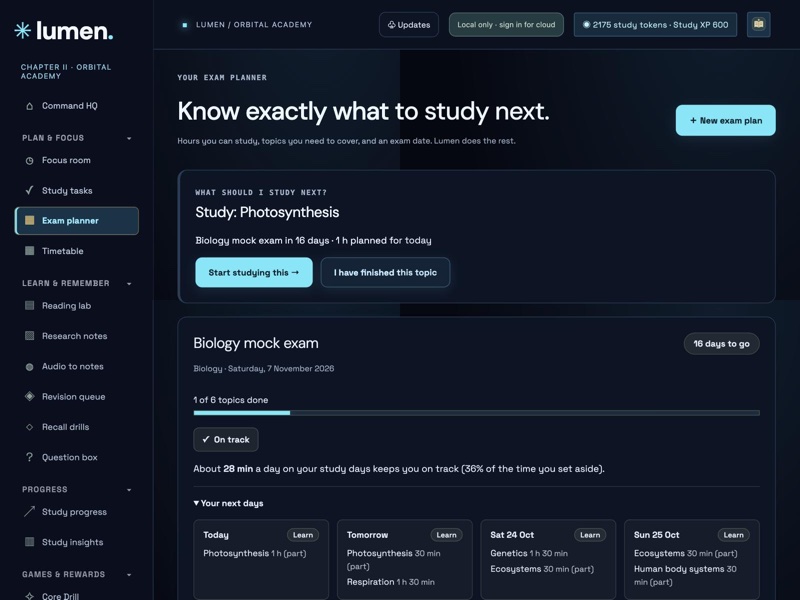
Write down the date of your first exam and count the days left. Then remove the days you know you cannot study: school events, family functions, travel. The number you are left with is your real study budget, and it is usually smaller than it feels.
Keep the last 7 to 10 days for revision only. New topics in the final week are stressful and rarely stick, so your plan should finish learning before then.
2. List every topic and rate how hard it is
Go through the syllabus for each subject and list chapters or topics, not just subjects. “Physics” is not something you can study in one sitting; “Laws of motion” is. Mark each topic as easy, medium or hard for you, not for the class.
- Hard topics get more time and come earlier, while you are fresh.
- Easy topics can fill short gaps, like 20 minutes after school.
- Topics that carry more marks in past papers deserve a little extra time.
3. Decide your daily hours honestly
Write how many hours you can study on each day of the week. School days might be 1.5 to 2 hours; weekends 3 to 5. If you plan 8 hours on a school day you will miss it, feel behind, and give up on the timetable. A smaller plan you keep beats a big plan you abandon.
4. Spread topics over the days
Divide your topics across the days before the revision week, mixing subjects so you are not doing six hours of one subject. A good day often looks like one hard topic, one medium topic and a short review of something you studied earlier in the week.
5. Build revision in from the start
Forgetting is normal: without review, most of what you learn fades within days. Add short reviews of each topic 1 day, 1 week and about 3 weeks after you first study it. Flashcards make this quick, because you only test yourself on the key facts.
6. When you fall behind, re-plan instead of quitting
You will miss days. When it happens, do not try to “catch up” by doubling tomorrow. Spread the missed topics over the remaining days and check whether you still have enough time. If not, drop the easiest, lowest-mark topics first and keep the revision week.
A sample week
- Monday (2 h): Laws of motion (hard), quick flashcard review of last week’s chemistry.
- Tuesday (1.5 h): Quadratic equations practice, review of Monday’s physics notes.
- Saturday (4 h): Two hard topics with breaks, then 30 minutes of past-paper questions.
- Sunday (3 h): Light day: catch up on anything missed, plan next week.
Questions
How many hours should I study for board exams?
Most students do well with 1.5 to 3 focused hours on school days and 3 to 5 on weekends. Consistency matters more than long days: two focused hours every day beat one eight-hour day a week.
When should I start making a timetable?
Ideally 8 to 12 weeks before your first exam, so you can cover every topic once and still keep a week or more for revision. If you have less time, start today and drop the lowest-mark topics first.
What should I do if I miss a day on my timetable?
Do not double the next day. Spread the missed topics over the days left and check that the revision week is still free. A planner that re-plans automatically, like the one in Study Hamlet, makes this easy.