
The Pomodoro technique for students: focus in 25-minute steps
Sitting down to “study for three hours” is hard. Sitting down for 25 minutes is easy. The Pomodoro technique turns long study days into short, focused rounds with real breaks.
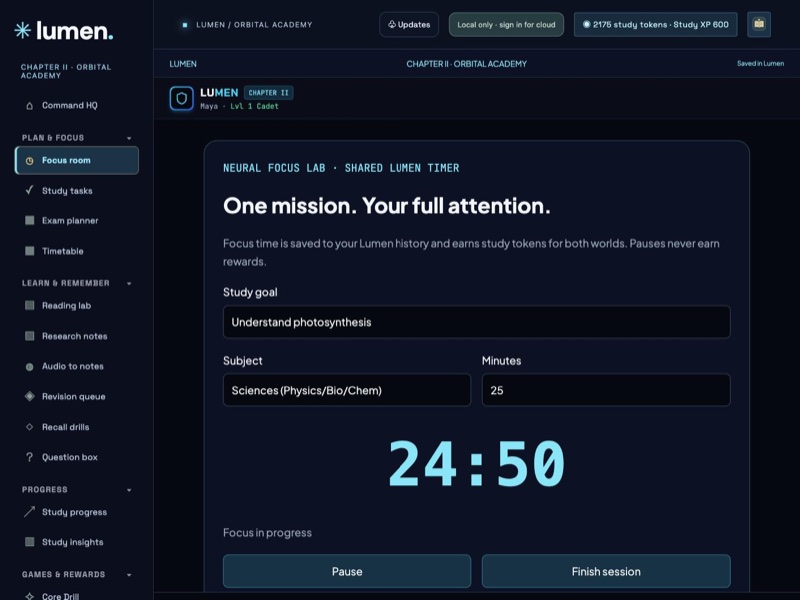
How it works
- Pick one task, for example “finish exercise 4.2”.
- Set a timer for 25 minutes and work only on that task.
- When the timer rings, take a 5-minute break: stand up, drink water, look away from screens.
- After four rounds, take a longer break of 15 to 30 minutes.
Each 25-minute round is called a “pomodoro”, after the tomato-shaped kitchen timer its creator used as a student.
Why it helps students
- Starting is easier. Twenty-five minutes feels small, so you procrastinate less.
- Focus is protected. You know a break is coming, so it is easier to ignore your phone until then.
- You can see progress. Counting pomodoros shows how much you really studied, which is often more motivating than counting hours.
- Breaks prevent burnout. Short regular breaks keep your attention fresh across a long day.
What to do when you get distracted
If a thought pops up (“I need to message my friend”), write it on a piece of paper and go back to work. Deal with it in the break. If you get pulled away completely, that round does not count: start a fresh 25 minutes. It sounds strict, but it trains your attention quickly.
Adapting it to you
- Younger students or tired days: try 15 minutes of focus and 5 of rest.
- Deep work like maths problems: try 50 minutes of focus and 10 of rest.
- Revision days: use one round for flashcards and the next for past-paper questions.
There is no single right length. Pick the longest time you can stay fully focused, then keep it consistent for a week before changing it.
Questions
Is 25 minutes the best length for studying?
It is a good starting point, not a rule. Many students prefer 45 to 50 minutes for maths or coding and 15 to 20 minutes on tired days. Choose the longest time you can stay fully focused.
What should I do during a Pomodoro break?
Move and rest your eyes: stand up, stretch, drink water or step outside. Avoid starting a video or game, because it is hard to stop after 5 minutes.
How many pomodoros should I do in a day?
Four to eight rounds (about 2 to 3.5 hours of focused work) is a strong study day for most students. Quality matters more than the count.